
Welded wire mesh is widely used for fencing, cages, reinforcement, partitions, guards, shelves, agricultural panels, and general industrial protection. Because the product looks simple, buyers sometimes send only a photo and a broad name. In practice, a reliable quotation needs several technical details: opening, wire diameter, material, roll or panel size, coating, tolerance, edge condition, packing, and destination requirements.
If your order is part of a larger product group, first check the wire mesh fence category or the reinforcement and construction mesh category, then prepare the welded mesh details below.
Roll mesh and panel mesh are not the same request
A welded mesh roll is usually quoted by roll width, roll length, wire diameter, opening, material, surface treatment, and packing. A welded mesh panel needs panel length, panel width, flatness expectation, cutting tolerance, edge style, stacking quantity, pallet size, and sometimes bending or frame welding. The production route and packing cost can change when a buyer changes from roll to panel.
For roll mesh, confirm whether the mesh should be tightly rolled or loosely rolled, whether the roll diameter is limited, and whether each roll needs a core, label, waterproof paper, woven bag, or pallet. For panels, confirm whether panels must remain flat after long-distance shipment and whether the destination warehouse can unload heavy pallets.
Opening and wire diameter control the main cost
The opening size and wire diameter have the strongest effect on material consumption and production arrangement. A 50 mm opening with 2.5 mm wire is not interchangeable with a similar looking mesh using 3.0 mm wire. If a buyer works from a local standard or project drawing, the drawing should be sent with the inquiry.
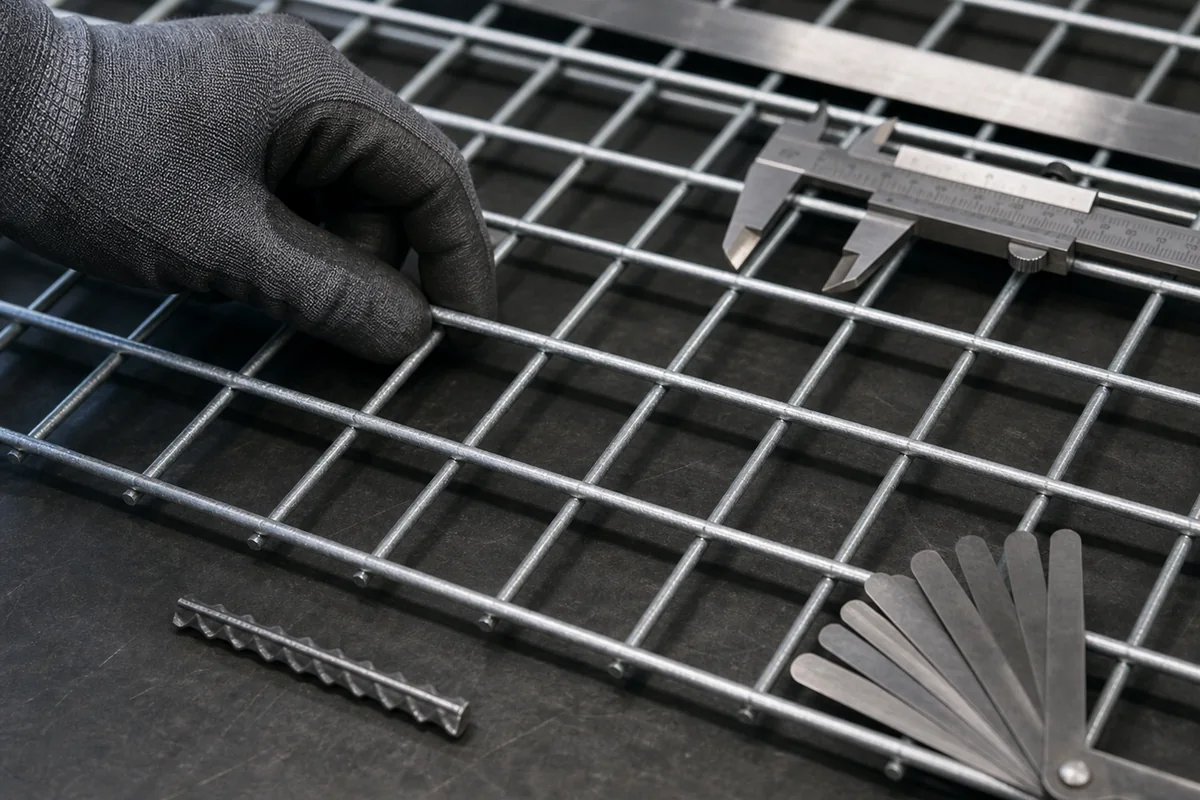
When measuring an old sample, measure several openings and wires instead of one point. Old or coated mesh may have surface variation. If the specification is written in inches or gauge, include the metric equivalent if possible. Clear units reduce mistakes during quotation and production confirmation.
Choose material and surface treatment together
Common welded mesh materials include low carbon steel wire, galvanized wire, stainless steel wire, and PVC coated wire. Surface treatment can be galvanized before welding, galvanized after welding, hot dipped galvanized, electro galvanized, PVC coated, or powder coated depending on the product type and use. Buyers should not select a coating name only by price. Outdoor use, humidity, chemical exposure, and expected service life should all be considered.
For stainless welded mesh, the buyer should define the grade, such as 304 or 316, based on the environment and end-use requirements. For galvanized welded mesh, the buyer should confirm whether the appearance of weld points matters and whether cut edges need extra attention. For PVC coated mesh, color, coating adhesion, and packing protection should be discussed before production.
Panel tolerance and edge condition need early agreement
Panel orders often fail because the size is treated as approximate. Before production, confirm whether the panel needs exact cut size, frame fitting, bolt-hole position, bent edge, trimmed edge, or smooth edge. If panels will be inserted into a frame or machine guard, small dimension differences can affect installation. A marked drawing is the best way to confirm this.
For welded mesh used as concrete reinforcement, the buyer should provide bar or wire diameter, spacing, panel size, overlap requirement, and project standard. For fence panels, confirm post spacing, panel width, panel height, bends if any, clip type, and coating color.
Inspection photos should match the specification
Useful inspection photos include wire diameter measurement, opening measurement, roll width or panel size, coating surface, weld points, cut edge, stacking method, label, pallet, and container loading. The photos should show the same specification that appears on the final order confirmation. For repeat purchases, keeping a simple photo checklist helps maintain consistency across shipments.
If you are comparing welded mesh with stainless woven mesh for a screening or filtration use, read the stainless steel wire mesh grade selection guide. For quotation review, send your welded mesh drawing or sample photo through contact Anping Mesh Factory.